
Key Takeaways
- Pre-screening questions turn clinical trial eligibility criteria into simple patient questions.
- Start with the protocol’s inclusion and exclusion criteria.
- Use clear, patient-friendly language without changing the criteria.
- Keep pre-screening questions separate from requirements needing formal screening.
- Review and update the questionnaire whenever the protocol changes.
A clinical trial protocol can run dozens of pages. The eligibility criteria may sit alongside study objectives, procedures, safety requirements, and other technical details.
A coordinator then has to find the rules that matter for pre-screening and turn them into questions a patient can actually answer.
That sounds simple. It is not always.
Miss one requirement, use outdated criteria, or write a question that changes the meaning of the protocol, and the questionnaire may no longer reflect the study.
So, how do you turn a clinical trial protocol document into a useful pre-screening questionnaire without making the process harder than it needs to be?
Quick Answer
To turn a clinical trial protocol into a prescreening questionnaire, extract the relevant inclusion and exclusion criteria, decide which ones can be checked during pre-screening, and convert them into short questions with clear answer options. Review the questionnaire against the current protocol before using it.
What Is a Clinical Trial Protocol?
A clinical trial protocol is the written plan for how a study will be conducted. It describes the study design, objectives, participant population, procedures, assessments, and other requirements.
Eligibility is a key part of that plan. FDA guidance says clinical trial protocols should clearly describe patient selection criteria, along with clinical procedures and other study requirements.
ICH E6(R3) also specifically includes participant inclusion criteria, exclusion criteria, and the mechanism for pre-screening and screening where appropriate.
For a research site, this means the protocol is the starting point. The pre-screening questionnaire should reflect the study’s actual requirements, not a separate interpretation of them.
Which Parts of the Protocol Become Pre-Screening Questions?
Not every line in a protocol belongs in a pre-screening questionnaire.
The first step is to find the inclusion and exclusion criteria. These define who can and cannot participate in the study.
For example, a protocol may require participants to:
- Be within a specific age range.
- Have a confirmed diagnosis.
- Have symptoms for a defined period.
- Meet a previous treatment requirement.
- Have certain medical history.
- Avoid specific medications.
- Meet certain time or treatment requirements.
Some of these can be checked during an initial conversation. Others may require a physical exam, laboratory test, imaging, or another formal screening procedure.
That distinction matters.
Pre-screening happens before formal screening and should stay limited to information that can be collected at that stage. Formal screening can involve additional procedures needed to confirm eligibility.
A simple rule
If the answer requires a test or clinical assessment that has not happened yet, it may not belong in the initial pre-screen.
Instead, flag it for the formal screening process.
How Do You Turn Protocol Criteria Into Pre-Screening Questions?
Once you have the relevant criteria, turn them into questions one by one.
Don’t copy the protocol word for word. Protocols are written for study teams and other research stakeholders. Patients need simpler language.
1. Start with one eligibility criterion
Suppose the protocol says:
Participants must be 18 to 65 years old. The pre-screening question can be:
Are you between 18 and 65 years old?
That is direct and easy to answer.
2. Break complex criteria into separate questions
A single protocol requirement may contain more than one condition.
For example:
Participants must have a confirmed diagnosis of X for at least six months and must not have received treatment Y within the previous 30 days.
Don’t turn this into one long question.
Instead:
- Have you been diagnosed with X?
- How long ago were you diagnosed?
- Have you received treatment Y within the last 30 days?
This makes each answer easier to record and review.
3. Use patient-friendly language
Technical wording can make a simple question difficult to answer.
Instead of:
Have you experienced a qualifying cardiovascular event within the protocol-defined period?
Ask:
Have you had a heart attack or stroke within the last six months?
The question should still match the protocol. Simpler does not mean changing the eligibility requirement.
4. Give each question a clear answer path
Use answer options that make the next step obvious.
| Protocol Requirement | Pre-screening Question | Possible Answer |
|---|---|---|
| Age 18–65 | Are you between 18 and 65 years old? | Yes / No |
| Confirmed diagnosis | Have you been diagnosed with the study condition? | Yes / No / Not sure |
| Symptom duration ≥6 months | How long have you had symptoms? | Less than 6 months / 6+ months |
| Restricted medication | Are you currently taking any medication that your doctor has told you to avoid for this study? | Yes / No / Not sure |
The goal is not to make the questionnaire complicated. The goal is to make the eligibility check consistent.
What Should a Good Pre-Screening Questionnaire Include?
A useful questionnaire should give the coordinator enough information to decide whether a full screening visit is worth pursuing.
Depending on the study, that may include:
- Basic information
Age, location, and other initial requirements. - Condition or diagnosis
Whether the patient has the condition being studied. - Relevant medical history
Conditions or events specifically mentioned in the eligibility criteria. - Previous and current treatment
Treatments, procedures, or medications that affect eligibility. - Timing requirements
How long the patient has had a condition or when a treatment occurred. - Key exclusion factors
Anything the protocol specifically identifies as a reason for exclusion.
Keep the list tied to the study. A pre-screening questionnaire is not supposed to collect every detail of a patient’s medical history.
What Is the Difference Between Pre-Screening and Formal Screening?
The two steps work together, but they are not the same.
| Pre-screening | Formal screening |
|---|---|
| Happens before formal screening. | Happens during the study’s formal screening process. |
| Uses limited initial information. | Collects more detailed eligibility information. |
| Can use phone, online, or other initial contact. | May involve visits, tests, labs, or other procedures. |
| Identifies potential candidates. | Confirms eligibility. |
| Helps avoid unnecessary screening visits. | Determines whether the participant meets the study requirements. |
A person can pass pre-screening and still fail formal screening.
That is normal. The first step identifies someone who may qualify. The formal process confirms whether they actually do.
How Do You Check a Questionnaire Against the Protocol?
This is the step that keeps a questionnaire from drifting away from the study.
Once the questions are written, compare them with the current protocol.
Check:
- Is every relevant inclusion criterion covered?
- Is every relevant exclusion criterion covered?
- Does each question mean the same thing as the original criterion?
- Are the time periods correct?
- Are age limits correct?
- Are treatment or medication requirements accurate?
- Are any questions asking for information that cannot be known during pre-screening?
- Are any questions adding requirements that the protocol does not contain?
The questionnaire should be traceable back to the protocol. If a coordinator cannot explain where a question came from, it is worth reviewing.
What Does a Clinical Trial Protocol Example Look Like?
Consider this simplified clinical trial protocol example:
Inclusion criteria
- Adults aged 18–65.
- Confirmed diagnosis of Condition X.
- Diagnosis for at least six months.
Exclusion criteria
- Current use of a restricted treatment.
- Certain medical conditions.
- Participation in another clinical trial within the previous 30 days.
The questionnaire could turn those criteria into:
- How old are you?
- Have you been diagnosed with Condition X?
- How long have you had the diagnosis?
- Are you currently receiving the restricted treatment?
- Have you participated in another clinical trial within the last 30 days?
Notice what happened.
The protocol stayed the source. The questionnaire simply changed the format of the information. That is the key to building good pre-screening questions.
Common Mistakes When Creating Pre-Screening Questions
Turning a protocol into questions sounds straightforward, but a few mistakes can create problems.
1: Copying the protocol directly
A clinical trial protocol is not written as a patient questionnaire. Copying technical language can make questions difficult to understand and answer.
Better: Keep the requirement intact, but simplify the wording.
2: Combining too many criteria
Long questions often contain several eligibility requirements. That makes answers harder to interpret.
Better: Use one clear question for each important criterion.
3: Leaving out exclusion criteria
Teams often focus on who qualifies and overlook who does not.
Better: Build the questionnaire from both inclusion and exclusion criteria.
4: Asking questions that require clinical confirmation
A patient may not know their current lab value or whether a clinical measurement falls within a specific range.
Better: Leave those requirements for the appropriate formal screening step when needed.
5: Using an outdated questionnaire
Protocol amendments can change eligibility requirements.
FDA guidance recognizes protocol amendments as part of the clinical trial process, and a changed criterion can affect the questionnaire built from it.
Better: Review and update the questionnaire whenever the protocol changes.
How Can You Make Protocol-to-Questionnaire Work Faster?
The manual process can take time.
A coordinator may need to read a long clinical trial protocol document, find every relevant eligibility requirement, write the pre-screening questions, check them against the source, and repeat the process after amendments.
That creates several opportunities for mistakes.
A clinical trial protocol extractor or digitizer can help by turning information inside a protocol into structured data. But extraction alone is not enough.
The questions still need to reflect the actual eligibility criteria and be reviewed before they are used. That is where an automated workflow can help.
How Calendax Turns a Protocol Into a Questionnaire
Reading a clinical trial study protocol is one task. Turning the relevant eligibility criteria into accurate screening questions is another.
That second step is where a lot of manual work starts. Calendax helps research teams skip that extra drafting work.
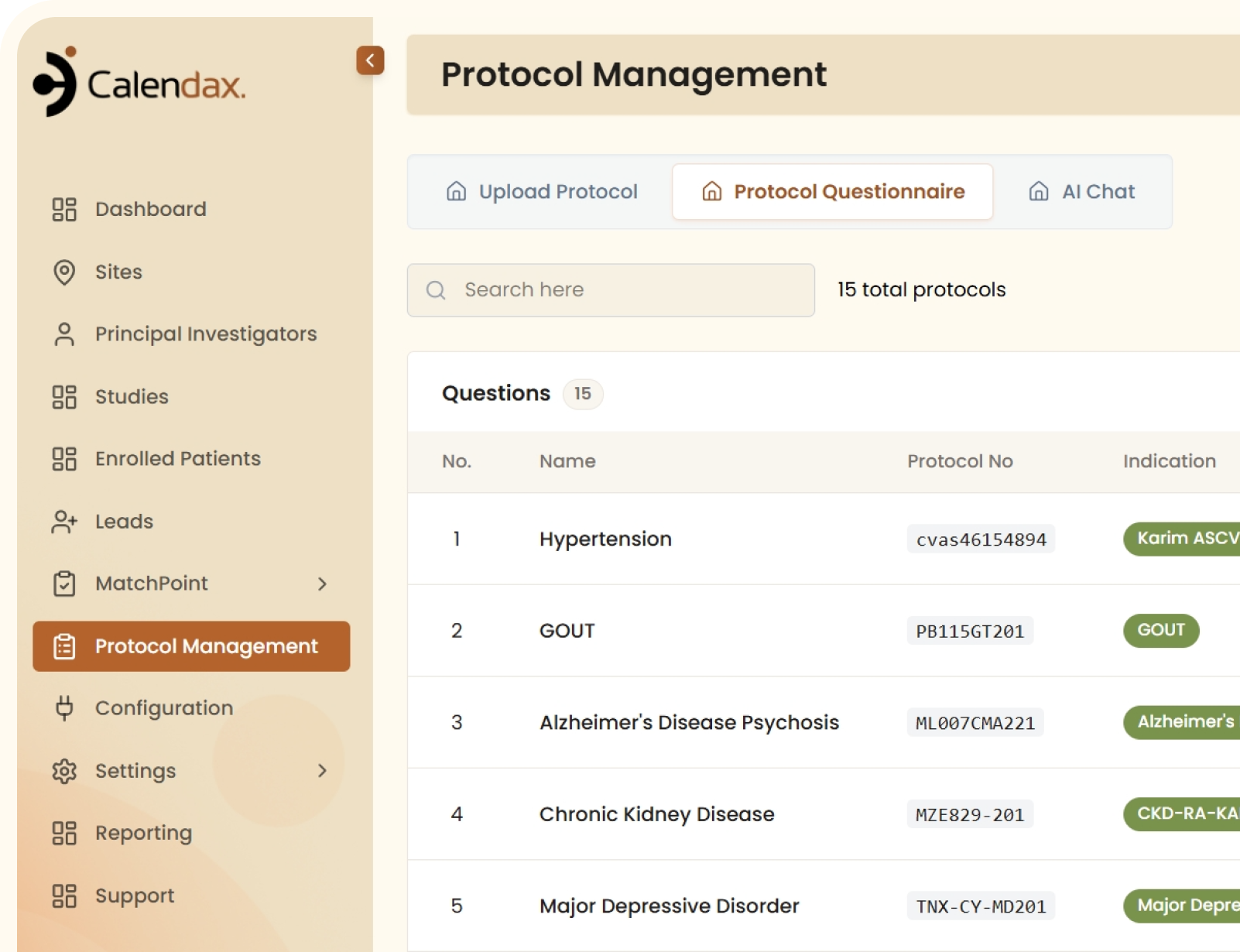
Upload the protocol, and Calendax identifies the inclusion and exclusion criteria and turns them into screening questions. Your team can then review, edit, and approve the questionnaire before it goes live.
What Happens When the Protocol Changes?
Protocol amendments can mean manually comparing changes and rewriting questions to make sure the questionnaire reflects the latest study requirements.
Calendax lets your team regenerate the questionnaire in seconds when a protocol is amended. CRCs can then review, edit, adjust, and approve the updated questions before they go live.
This helps keep the questionnaire aligned with the current protocol without making your team rebuild it from scratch.
What Happens After the Questionnaire Is Ready?
The work does not stop once the questions are created.
During a live calling session, Calendax keeps the approved questions on screen while the coordinator speaks with the patient. Live transcripts capture the conversation, and the screening outcome is saved to the patient’s profile.
The AI screening agent can also handle initial screening based on the approved questionnaire and configured calling rules.
That means coordinators spend less time repeating questions, writing notes, and reviewing routine calls.
AI handles the repetitive work. Your team stays in control of the screening process and any decisions that require human judgment.
Ready to Turn Your Next Protocol Into a Screening Questionnaire?
Upload your protocol to Calendax and move from manual drafting to a reviewed, ready-to-use questionnaire in minutes.
Conclusion
A clinical trial study protocol tells the research team who can participate and how the study should run. A pre-screening questionnaire turns the relevant eligibility rules into questions a potential participant can answer.
The process does not need to be complicated.
Find the criteria. Simplify the language. Build clear questions. Review them against the protocol. Keep them updated.
The biggest risk is not writing too few questions. It is creating questions that no longer match the study.
A structured workflow helps prevent that. Automation can handle the repetitive work of extracting criteria and drafting questions, while research teams stay in control of review and approval.
FAQs
What are pre-screening questions in a clinical trial?
Pre-screening questions are initial questions used to find out whether a potential participant may meet a study’s eligibility criteria before formal screening.
How do you create a pre-screening questionnaire?
Start with the current clinical trial protocol. Extract the relevant inclusion and exclusion criteria, decide which can be checked during pre-screening, and turn each one into a clear question with suitable answer options.
What is the difference between screening and pre-screening?
Pre-screening is an initial eligibility check. Formal screening is the more detailed process used to confirm eligibility and may include clinical assessments, laboratory tests, or other study procedures.
Should every inclusion and exclusion criterion become a pre-screening question?
No. Some criteria may require information or assessments that are not available during initial contact. Only include criteria that can be appropriately checked during pre-screening.
How often should a pre-screening questionnaire be updated?
It should be reviewed whenever the protocol or its eligibility criteria change. The questionnaire should reflect the current approved requirements.
Can AI create a clinical trial pre-screening questionnaire?
Yes. AI can help extract eligibility criteria from a protocol and turn them into draft questions. The research team should still review and approve the questionnaire before it is used.
What should a good pre-screening questionnaire avoid?
It should avoid unnecessary medical questions, unclear wording, combined eligibility criteria, outdated requirements, and questions that require formal clinical testing to answer.